Choosing the Right AI Model: Bigger Isn't Always Better
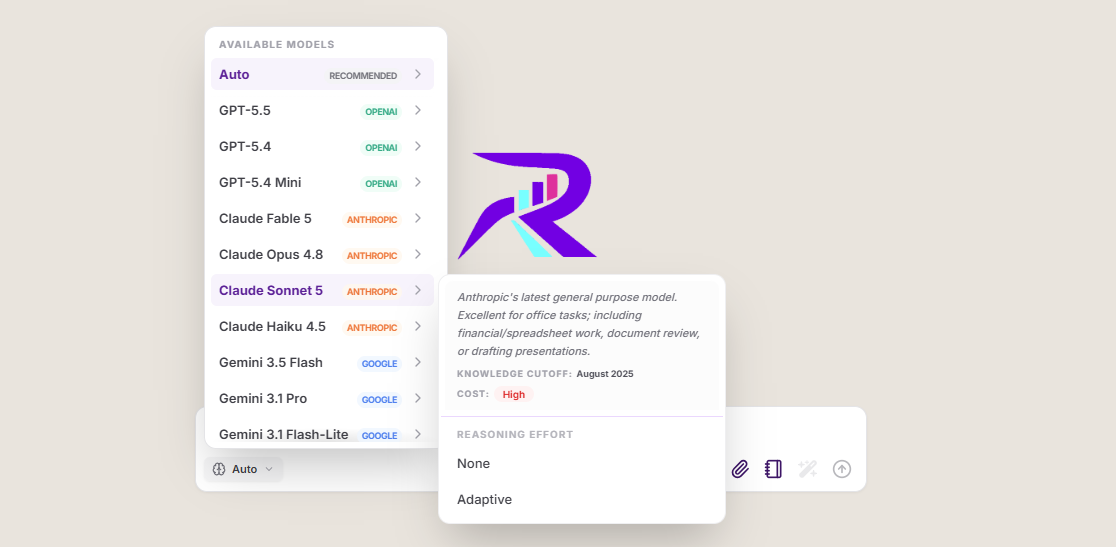
AI models are getting better fast, but that doesn't mean the biggest model is always the right one. In actual fact, the opposite is often true. For businesses trying to get real value from AI, the goal shouldn't be to use the most powerful model available just because it exists. The smarter approach is to match the model to the task.
That matters for two reasons: cost and quality. Some models are brilliant at deep reasoning, long-form writing, or complex analysis, but they can also be slower and more expensive. Others are lighter, faster, and far cheaper — yet still perfectly capable of handling everyday work such as summarising documents, drafting emails, classifying information, or pulling out key points from a report.
The trick is understanding what each model is good at, when it's worth paying for more horsepower, and when a leaner option will do the job just as well.
Different models, different strengths
There's no single "best" AI model. Each one has its own strengths, trade-offs, and ideal use cases.
OpenAI models tend to be strong all-rounders. The higher-end models are usually better for complex reasoning, nuanced writing, and multi-step tasks where accuracy and judgement matter. They're often the safer choice when the output needs to be polished or when the task involves a bit of logic rather than simple pattern matching. The lighter versions are usually faster and cheaper, and can be a great fit for routine work where speed matters more than depth.
Claude models are often favoured for writing-heavy tasks, document analysis, and thoughtful responses. They tend to be especially useful when you want the AI to work through a large amount of text and produce something clear, structured, and well written. The premium Claude models are typically more capable with complexity, while the smaller models can be excellent for summarisation, extraction, and everyday drafting.
Gemini models are often strong where speed, scale, and practical utility matter. They can work well for broad knowledge tasks, quick summaries, and processes that benefit from a responsive, efficient model. In some cases they're a very cost-effective option for high-volume work.
Then there are newer players like DeepSeek, Qwen, Kimi, GLM, and Minimax, which are increasingly worth paying attention to. These models are part of a fast-moving market and, in many cases, offer strong performance for a lower price point. That's important, because it means businesses are no longer locked into choosing between "good" and "affordable". In a lot of cases, there are now genuinely capable cheaper options that can handle a surprising amount of work.
When to use a cheaper model
A lot of people assume that lower-cost models are only suitable for low-value tasks. That is not the case.
Cheaper models are often ideal for:
- Summarising long documents or meeting notes
- Extracting key information from structured text
- Drafting first versions of internal emails or content
- Classifying enquiries, documents, or data
- Answering simple, repeatable questions
- Routine process automation where consistency matters more than creativity
For these tasks, a premium model may be overkill. You're paying more without necessarily getting a meaningful uplift in output quality. In many cases, the cheaper model gives you 80 to 90 per cent of the result at a fraction of the cost. If you're running that task dozens or hundreds of times, the savings add up quickly.
When a premium model is worth it
There are times when paying for a stronger model absolutely makes sense.
Use a higher-end model when the task involves:
- Complex reasoning
- Multiple steps of analysis
- Sensitive client-facing writing
- Nuanced judgment calls
- Large, messy, or ambiguous inputs
- High-stakes outputs where accuracy really matters
If the work is messy or the answer needs careful interpretation, a better model can save time, reduce rework, and improve confidence in the result. That's especially true in professional services, where one weak output can create more effort downstream than the model cost ever saved.
How to choose the right model
A simple way to think about it is this:
- Start with the task
- Is it summarising, drafting, extracting, or analysing?
- Is it repetitive or one-off?
- Does it need polish, or just usefulness?
- Think about risk
- If the output is internal and can be checked, a cheaper model may be enough.
- If it's client-facing or commercially sensitive, you may want a stronger model.
- Test before you scale
- Don't assume the most expensive model will win.
- Try two or three models on the same task and compare quality, speed, and cost.
- Watch the cost per outcome, not just the cost per call
- A model that costs less but needs more editing might not actually be cheaper.
- A model that costs more but gets you there in one shot might save time overall.
- Keep refining
- The best setup is often a mix of models, not just one.
- Different tasks call for different tools.
The smart choice is always the right-sized model
AI selection is becoming less about chasing the top-tier model and more about finding the right fit. The best organisations won't be the ones using the highest-end model for everything. They'll be the ones who understand when to spend, when to save, and how to get the best output for the lowest sensible cost.
That's where the market is heading: more choice, more specialisation, and more pressure to be deliberate. The good news is that this works in your favour. You don't need to overpay to get good results. In many cases, a lighter model is more than enough.
That's where Dojo helps. We give teams access to the major model families, so they can choose the right one for the task instead of forcing everything through a single option. We're also internally trialling some lower-cost models that aren't publicly available yet, because in the right process, they can do an excellent job without the higher price tag.
The real win with AI is not using the biggest model for everything, but using the right one for the job. Make that choice well, and you can reduce cost, improve results, and build a more practical AI setup over time.
See the difference for yourself
Try Dojo free for 14 days. Compare the models in one platform, test what works best for your team, and find the right balance between cost and output.