If AI takes on the routine work, what should junior accountants learn?
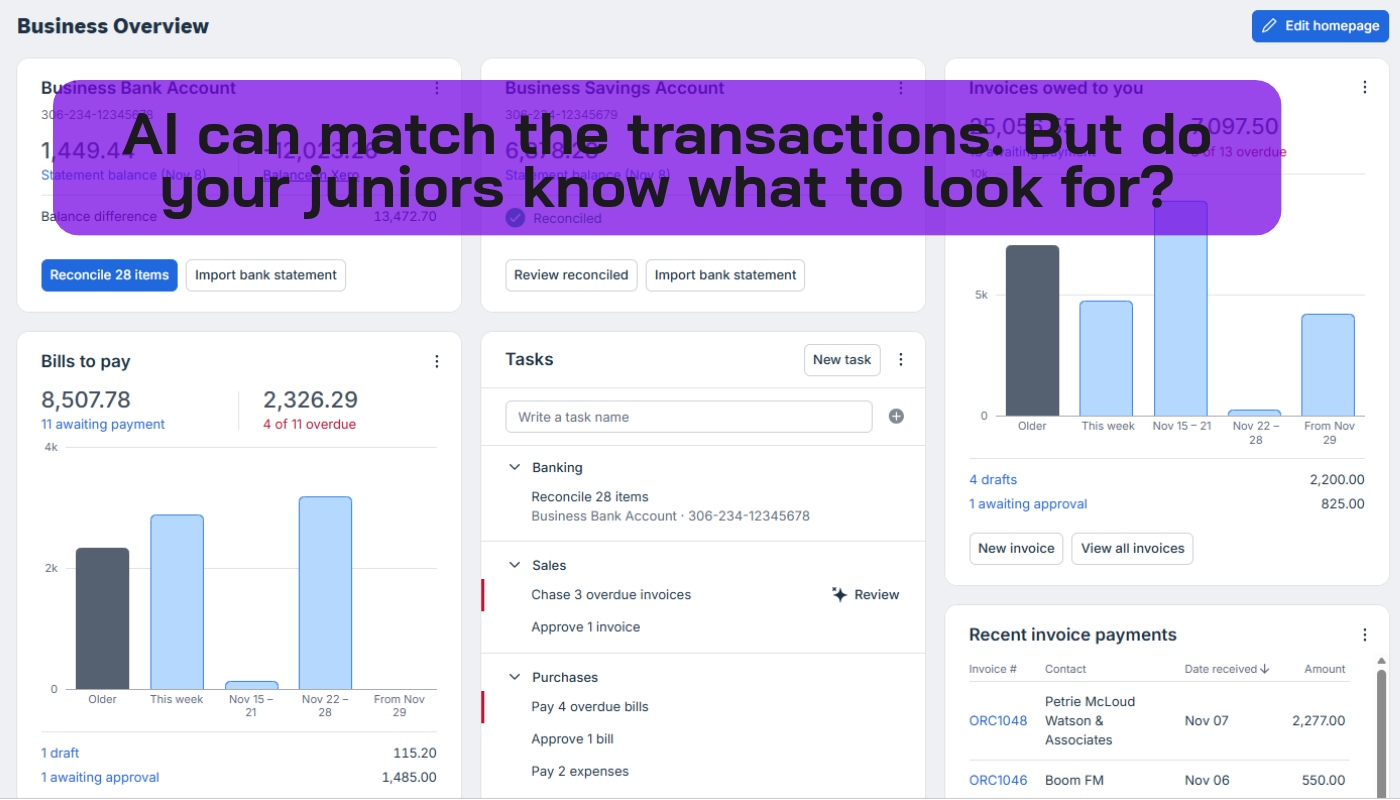
AI can help take some repetitive tasks off an accounting team. But if junior accountants do less of that work, firms need to be deliberate about how they build the judgement and confidence that experience brings.
For many accountants, the first few years in the profession involve plenty of work that isn't particularly exciting: checking figures, sorting documents, reconciling transactions and preparing routine schedules. It can feel like the stuff you do before you get to the real work.
But these tasks are also where people learn how the pieces fit together. They start to notice what looks unusual, ask better questions and understand why a number matters, not just where it goes.
As AI takes on more of the repetitive work, accounting firm owners and managers face a question that's easy to overlook: if juniors do less of the groundwork, how will they build the experience needed to check and challenge the work AI produces?
Routine work has always been part of the learning
Junior accountants build their judgement gradually by seeing different client situations, making mistakes in a supervised environment and talking through why something doesn't look right.
A bank reconciliation, for example, isn't only about matching transactions. It can teach someone to recognise timing differences, notice a missing item and understand when a small discrepancy might point to a bigger issue.
AI may be able to speed up parts of this process. That can be useful, especially when teams are under pressure and manual, routine work is taking time away from clients. But faster preparation doesn't necessarily mean a junior has learned how to assess the result.
A study covered by Stanford Graduate School of Business looked at survey responses from 277 accountants and task-level data from 79 small and mid-sized firms. It found that accountants using AI completed monthly statements faster and spent less time on routine processing. It also found differences in how people worked with AI: more experienced accountants were more likely to step in when an output seemed uncertain, while less experienced accountants were more likely to accept it at face value. These are findings from a particular study, not a rule for every firm, but they raise an important question about how teams teach review skills.
Checking AI is a skill, not a final step
It's tempting to think of review as the last step: AI prepares something, then a senior accountant checks it before it goes out. But good review takes knowledge. You need to know what to look for, what questions to ask and when a result deserves a closer look.
That's why firms shouldn't treat AI as a way to remove junior staff from routine work altogether. They can use it to reduce repetitive effort while still involving juniors in understanding the task, checking the result and following up on anything that doesn't make sense.
That might mean asking a junior to explain why an item has been flagged, trace a figure back to its source, or identify what information is missing before a draft is finalised. The aim isn't to make people repeat work AI can handle. It's to make sure they're learning from the work that remains.
CPA Australia makes a similar point in its guidance for firms: AI can help with routine work, but people still need to check the output and remain responsible for the result. The article also discusses how junior accountants can develop critical thinking skills to help review AI-supported compliance work.
Give juniors a clear role in AI-assisted work
A useful starting point is to be clear about what the junior is responsible for when AI is involved. "Check the output" is too vague, particularly for someone who is still learning.
Instead, give them specific things to verify. Depending on the task, that could include whether the information is complete, whether figures agree to the source documents, whether anything has been treated inconsistently, or whether a conclusion needs a more experienced person's input.
It also helps to talk through the reasoning. If a senior accountant changes an AI-generated draft, explain what was wrong and why it mattered. If a junior raises a question, make time to work through it rather than simply providing the answer. Those conversations are where professional judgement grows.
CPA Australia's AI Hub recommends using generative AI for first drafts and ideas, not as the final word. It also says accountants should not treat it as an authoritative source on accounting standards, laws or regulatory requirements. That's a helpful principle for junior staff too: use AI to assist, then verify important information and apply professional judgement.
Training may need to change
If AI changes what juniors do day to day, firms may need to adjust how they train them. That doesn't mean you'll need to build a whole new grad programme overnight. It could just start with a few practical changes.
Make the purpose of a task clear, not just the steps to complete it. Give juniors opportunities to practise reviewing exceptions and incomplete information. Talk openly about where AI is useful, where it can be wrong and when to ask for help. And even when AI prepares a first pass, make sure juniors understand the source material and the decisions being made.
This is important for senior accountants, too. If more routine work is handled differently, experienced staff may spend less time correcting basic errors and more time coaching, explaining decisions and helping juniors build confidence. This needs to be intentional, and it can be hard to make room for when the team is busy. But it's important to not leave learning to chance, particularly if the work that once gave people their early experience is changing.
Keep the goal in view
AI doesn't have to mean choosing between preserving the old way of training and automating everything. Firms can take routine effort out of a workflow while keeping the learning, supervision and professional judgement that make the work reliable.
For firm owners, the practical question is not simply, "Which tasks can we automate?" They also need to consider, "What will our people need to learn to do those tasks well, review the output and take responsibility for the result?"
The firms that answer both questions are more likely to build teams that can use AI with confidence, rather than teams that either avoid it completely or trust it too quickly.
Want to see how AI could support your team's accounting workflows while keeping your people in control?
Book a demo with Dojo and we'll show you what it can look like in practice.