Why Prompting Is the Most Underrated Skill in Your Firm Right Now

We have been working with Australian accounting firms of varying sizes for over 12 months now. What we notice is that when we initially start working with firms, most accounting professionals using AI are only getting somewhere between underwhelming and useful results. This isn't because the technology is limited, but because they haven't been taught how to communicate with it properly. The difference between a mediocre output and a useful one comes down to a simple framework.
Through our work across the accounting profession on AI adoption, the pattern is consistent — the professionals getting real value aren't more technically minded or more experienced with the tools. They're simply more deliberate about how they structure a request. And that is a skill we can teach you. Here it is.
Every Prompt Has Three Layers
When you give AI a task, you're actually asking for three separate things at once (whether you're conscious of it or not). We call this the OPB Framework: Output, Process, Behaviour.
Output — what you actually want back. The format, the audience, the tone, the length. A memo looks different from a bullet list. Something written for a client reads differently from something written for an internal file note. If you don't define this upfront, AI fills the gaps with its own defaults, which may have little relation to what you actually needed.
Process — how you want AI to approach the work. Should it think through the key considerations before drafting? Should it check for gaps first and confirm scope before writing? The order of operations matters, and structured, staged requests consistently produce better outputs than open-ended ones.
Behaviour — how you want AI to engage throughout the task. Should it be concise or detailed? Supportive or willing to challenge your thinking? These shape the quality and usefulness of everything that comes back.
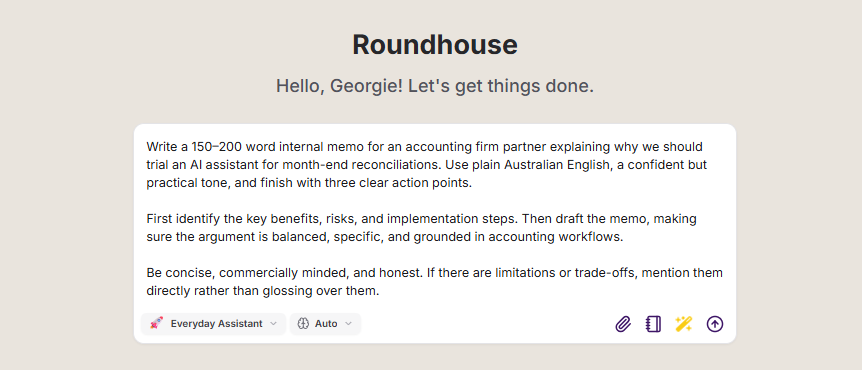
The example above is a good illustration of the OPB framework in action — output, process and behaviour are all clearly defined upfront. Most people only address one of these layers or maybe two. The professionals getting the best results are consciously determining all three before they begin.
Before You Prompt, Answer Four Questions
Four questions are most important when it comes to defining your output.
- What format do you want? A numbered list, a draft email, a table, a checklist — name it specifically. "A numbered list of no more than five items" produces something fundamentally different from an open-ended response to the same question.
- Who is the audience? A client with no tax background needs plain language and no jargon. A CFO needs precision and appropriate technical depth. Audience shapes tone and detail in ways that are genuinely difficult to fix after the fact.
- What tone fits the context? "Plain English, direct, no jargon" consistently outperforms "professional" as a tone instruction. Vague directions produce vague outputs.
- What's in scope — and what isn't? Being specific about what you want covered, and equally specific about what to exclude, saves considerable editing time. "Cover trustee powers only. Ignore distributions." That level of precision makes a measurable difference to the quality of what comes back.
These four questions take under a minute to work through. Skipping them costs far more time on the back end and produces substandard results.
How You Run the Work Matters as Much as What You Ask
Three habits consistently separate strong AI users from average ones.
- Think first, then draft. Ask AI to outline the structure or list the key issues before writing anything. "List the issues you will cover, then wait for my confirmation." This surfaces gaps early and gives you control over the direction before you're already committed to a draft you need to unwind.
- Break complex tasks into steps. "Identify the issue, list the key considerations, then draft the response." Structured, sequential prompts perform better than asking AI to do everything at once. Open-ended requests tend to produce responses that are broad but shallow — covering a lot of ground without the depth that makes them genuinely useful.
- Treat it as an iterative conversation. The first response is rarely the final one, and it doesn't need to be. Each follow-up turn adds context, refines the output, and gets you closer to what you actually need. The professionals who get the best results treat AI as a thinking partner that improves with direction, not a tool that either works or doesn't on the first attempt.
You Can Shape How AI Engages
AI has default settings — it tends to sit somewhere in the middle on length and lean toward being agreeable. Neither of those defaults is always appropriate for professional work, and most people don't realise they can change them.
If you need a detailed analysis, say so explicitly. If you need something concise, specify that too. If you want genuine pushback on your reasoning, ask for it directly: "Challenge the assumptions in this approach before drafting a response." And if you want AI to adopt a specific role — "You are a senior manager reviewing a junior's draft" — that framing produces meaningfully different output than a generic, unconfigured request. Length, posture, and role: state all three, and you'll notice the difference immediately.
The Mistakes Worth Recognising Early
Three patterns consistently underperform across every firm we work with.
- The one-line prompt — a single sentence with no output format, process, or behaviour defined — leaves AI to fill every gap with its own defaults. Sometimes that's fine but more often, it produces something that's technically responsive but not quite right, requiring significant rework that defeats the purpose of using AI in the first place.
- Buried instructions are equally problematic. When the actual task sits at the bottom of several paragraphs of context, AI can end up prioritising the framing over the request itself. Leading with the task and keeping context secondary produces consistently cleaner results.
- Mixing multiple tasks into a single prompt tends to result in each one being addressed only partially. Where possible, run separate tasks separately, or sequence them with clear signposting so AI knows where one ends and the next begins.
Where to From Here
AI is an extremely powerful tool for accounting work: drafting client communications, structuring complex analysis, summarising lengthy material, working through technical considerations. But unlocking that value requires deliberate communication, and most people were never shown how to do it properly.
The framework here isn't complicated, it just needs to be applied consistently. Prompting is a skill, and like any professional skill, it compounds the more deliberately you practice it.
Ready to put this into practice?
AI Dojo is built specifically for accounting firms, with AI assistants that are already trained for the work you do every day. Get started or book a demo to see it in action.